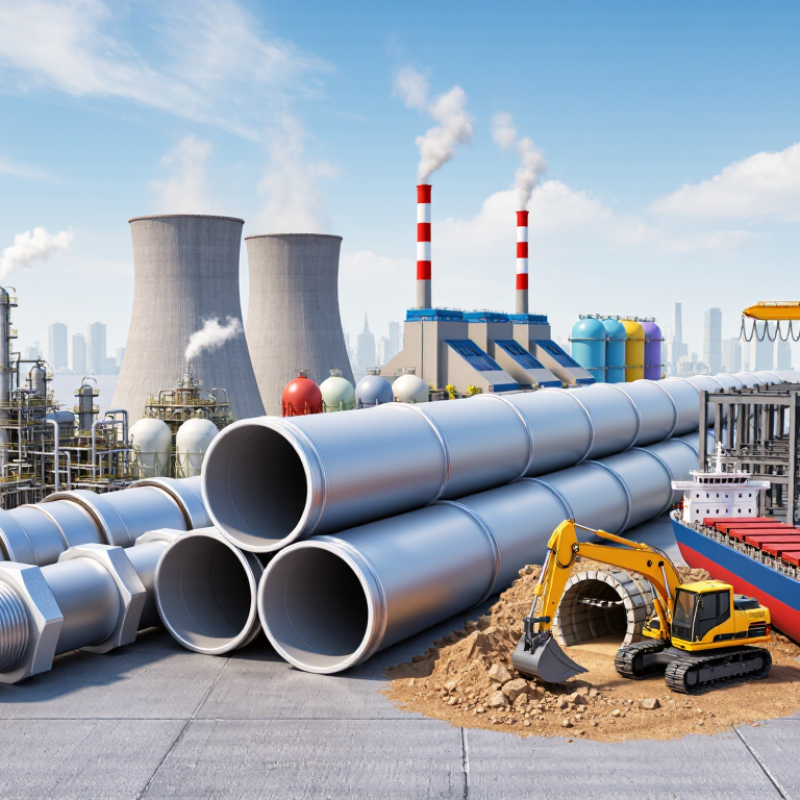
When asking “what industries use alloy steel pipes,” many professionals think of oil and gas first. That answer is correct, but incomplete. Alloy steel pipes also serve power generation, chemical processing, construction, shipbuilding, mining, and heavy equipment manufacturing. Their strength comes from added elements such as chromium, molybdenum, nickel, or vanadium. These additions improve performance under heat, pressure, impact, or corrosive conditions.
A refinery may use alloy pipe near high-temperature process units. A power plant may depend on it for steam lines and boiler connections. Mining systems face abrasion, vibration, and changing temperatures. Construction projects often select alloy steel for structural supports, pressure systems, or demanding mechanical applications. The right choice depends on temperature, pressure, fluid chemistry, wall thickness, welding requirements, and applicable standards. It is not only about choosing the strongest pipe.
That sounds simple, but it is not.
Experienced engineers review material certificates, inspection records, dimensions, and heat-treatment conditions before approval. They also check whether the selected grade matches the actual service environment. A visually perfect pipe can still fail when its chemistry or weld procedure is unsuitable. This guide presents seven practical tips for understanding where alloy steel pipes are used and how industries select them. Some applications overlap, and supplier claims deserve careful verification. Real projects are rarely as neat as product brochures suggest. Reliable decisions come from combining field experience, technical data, qualified inspection, and honest risk assessment.
Alloy steel pipes serve thermal power, refineries, petrochemical plants, and process-heating systems. ASTM A335 defines them more precisely than the phrase “alloy steel” suggests. Chromium content is the key clue. P11 contains about 1–1.5% chromium, while P22 contains about 1.9–2.6%. P5 rises to 4–6%, and P9 reaches 8–10%. P91 also contains roughly 8–9.5% chromium, with vanadium, niobium, and nitrogen additions. These elements support oxidation resistance, creep strength, and high-temperature stability.
Seven practical checks matter: confirm the ASTM A335 grade, compare chromium and molybdenum levels, verify design temperature, inspect seamless construction, review welding procedures, require post-weld heat treatment, and check material traceability. P22 often suits demanding boiler and steam-service conditions. P9 can offer stronger oxidation resistance in hotter refinery or furnace environments. However, more chromium is not automatically safer. The correct grade depends on pressure, temperature, weld design, and corrosion conditions.
The IEA Gas 2024 report recorded global gas-demand growth of about 2.5% in 2024, with further growth forecast for 2025. EIA’s International Energy Outlook projects global energy consumption to rise substantially through 2050. Those figures support continued demand for high-temperature piping. Still, material selection is often oversimplified. A pipe may meet chemistry limits yet fail through poor heat treatment or weak documentation. That detail deserves more attention.
Power plants remain a major alloy steel pipe market. The IEA Coal 2024 report states that global coal demand reached about 8.7 billion tonnes in 2023. Many boilers still operate with steam between 500°C and 600°C. At these temperatures, creep strength matters more than simple tensile strength.
Tip 1: Match the grade to the real metal temperature. P11 contains about 1.25% chromium and 0.5% molybdenum. It suits moderate superheater and reheater duties. P22 contains about 2.25% chromium and 1% molybdenum. Its stronger creep resistance often supports hotter sections. ASME SA-335 and SA-213 provide the main material requirements. Do not select by temperature alone.
Tip 2: Check pressure, wall thickness, and service hours. The US Department of Energy’s NETL baseline studies commonly evaluate advanced steam cycles near 540°C to 600°C. These conditions increase oxidation, thermal fatigue, and creep damage. P22 may be the safer choice near 600°C, but fabrication quality remains critical. A poor weld can defeat a good alloy.
Tip 3: Review the plant’s inspection records. EPRI guidance repeatedly emphasizes weld heat treatment, hardness control, and creep monitoring for Cr-Mo piping. P11 can reduce material and fabrication costs in lower-temperature zones. P22 may offer longer life in hotter zones. The boundary is not perfect. Actual tube-metal temperature, not steam temperature alone, should guide the final decision.
Indicative steam-temperature bands for common alloy-steel pipe applications. P11 is commonly selected for moderate-to-high temperature service, while P22 is frequently used for higher-temperature boiler, superheater, and reheater circuits around 500–600°C. Final material selection must follow the applicable design code, pressure, chemistry, and allowable-stress requirements.
Temperature ranges are representative engineering application bands, not material code limits or design recommendations.
Oil and gas systems above 10,000 psi demand careful pipe selection. API 5L compliance helps confirm material, manufacturing, and testing requirements. It does not prove that every pipe can handle this pressure. Engineers must check grade, diameter, wall thickness, temperature, and design code. Pressure design comes first.
Choose a suitable strength level and confirm the pipe’s chemical composition. Alloying elements can improve strength, toughness, and resistance to harsh service. Ask for mill test certificates, heat numbers, hydrostatic records, and nondestructive testing results. Traceability matters. Verify sour-service requirements when hydrogen sulfide may be present. A small material mismatch can cause serious problems.
Inspect the pipe ends, weld areas, and internal surface before installation. Confirm dimensional tolerances against the project drawings. Calculate pressure losses and consider erosion near valves, bends, and reducers. Use qualified welding procedures and review heat treatment records. Do not select a higher grade only because it sounds safer. It may create welding difficulties or unnecessary cost. I have seen specifications fail when pressure was checked, but temperature and corrosion allowance were ignored. That is an easy mistake to repeat. Procurement teams should also confirm applicable regional codes, inspection plans, and independent verification before shipment.
Petrochemical plants often use alloy steel pipes where temperature, pressure, and corrosion challenge ordinary carbon steel. At 400°C, material selection must follow a disciplined ASME B31.3 evaluation, not a simple grade comparison. The engineer should verify design pressure, metal temperature, allowable stress, weld efficiency, flexibility, and cyclic loading. Heat changes everything.
Corrosion risks can remain hidden. Sulfidation may thin pipe walls in sulfur-bearing streams, while oxidation can attack exposed surfaces. Wet shutdown conditions may also create localized corrosion beneath insulation or deposits. A practical review should compare the expected corrosion rate with the required corrosion allowance and inspection interval. Ultrasonic thickness readings, weld records, and process chemistry provide stronger evidence than visual checks alone.
A weakness in many assessments is treating 400°C as a constant operating condition. Startups, shutdowns, temperature swings, and dead legs may cause different damage mechanisms. Creep, thermal fatigue, and carburization deserve attention when exposure is prolonged. ASME B31.3 supports decisions on design, fabrication, examination, and testing, but it does not replace site-specific corrosion analysis. Confirm material certificates, heat treatment, weld procedures, and traceability before installation. Document it. If the fluid composition is uncertain, assumptions should be recorded and challenged during the next process review.
Alloy steel pipes serve refineries, power stations, chemical plants, and high-temperature process lines. Pipe selection starts with dimensions, not appearance. ASME B36.10 defines nominal pipe sizes, outside diameters, wall thicknesses, and schedules for many welded and seamless steel pipes. It does not approve every design.
Check the nominal pipe size, or NPS, before comparing products. An NPS 6 pipe keeps a 6.625-inch outside diameter across several schedules. Schedule 40 has a thinner wall than Schedule 80, so its internal diameter is larger.
That difference affects flow, weight, welding access, and pressure capacity. Do not treat schedule numbers as pressure ratings. Material grade, temperature, corrosion allowance, and design code also control safe service limits.
Confirm whether the project requires seamless or welded construction. Match the listed wall thickness with ASME B36.10 tables, then check mill tolerances and actual inspection records. Consider elbows, flanges, and valves together, because mismatched dimensions create installation problems. Review corrosion and heat exposure, especially in furnace piping or steam systems. Ask for traceable test certificates. A certificate alone is not enough.
One detail is often missed.
Schedule names can look familiar while wall thicknesses differ between size ranges. I have seen specifications copied without checking the table edition. That shortcut can create costly rework. Recheck every dimension against the project’s governing standard and service conditions.
Alloy steel contains elements such as chromium and molybdenum. These additions improve heat resistance, creep strength, and oxidation control.
Lower-alloy grades may contain about 1–1.5% chromium. Higher grades can reach roughly 8–10%.More chromium is not automatically safer. Pressure, temperature, welding, and corrosion still control the decision.
Typical applications include steam systems, refineries, petrochemical units, furnaces, and process-heating equipment.These systems may face hot metal surfaces, pressure, and corrosive fluids. Heat changes everything.
No. Engineers must check grade, diameter, wall thickness, temperature, and the applicable design code.A high-strength grade alone proves little. Pressure design comes first.
Request material certificates, heat numbers, hydrostatic test records, dimensional reports, and nondestructive examination results.Welding and heat-treatment records also matter. Traceability matters.
Alloy additions can increase strength but make welding more demanding. Qualified procedures help control cracking and mechanical-property changes.Post-weld heat treatment may be required. Skipping it can create hidden weaknesses.
Review sulfidation, oxidation, carburization, thermal fatigue, creep, and corrosion beneath insulation or deposits.Wet shutdowns may create localized attack. Visual inspection may miss it.
Compare the expected corrosion rate with wall thickness allowance and the planned inspection interval.Use ultrasonic thickness readings and process chemistry. Do not rely on appearance alone.
Temperature swings can cause thermal fatigue and expose damage mechanisms absent during steady operation.Dead legs may behave differently. That detail is easy to overlook.
Choosing a higher grade without checking weldability, cost, corrosion conditions, or documentation.It sounds safer. It may be wrong.
Alloy steel pipes are widely used in industries that require strength, heat resistance, and reliable pressure performance. Understanding what industries use alloy steel pipes begins with their composition and standards, including ASTM A335 grades and chromium content. Power plants commonly select grades such as P11 and P22 for steam systems operating around 500–600°C, where resistance to high temperature and long-term stress is essential. These pipes help support boilers, superheaters, and other critical process lines.
In oil and gas applications, API 5L alloy pipes may be considered for high-pressure service above 10,000 psi, provided that material selection and testing match the operating conditions. Petrochemical facilities must also evaluate corrosion risks near 400°C by applying ASME B31.3 design principles and reviewing the chemical environment. Finally, pipe size, wall thickness, and schedule should be compared with ASME B36.10 requirements to ensure proper flow capacity, mechanical strength, and installation compatibility across industrial systems.

Flowtera Pipe